A Polemic Against Scrolling
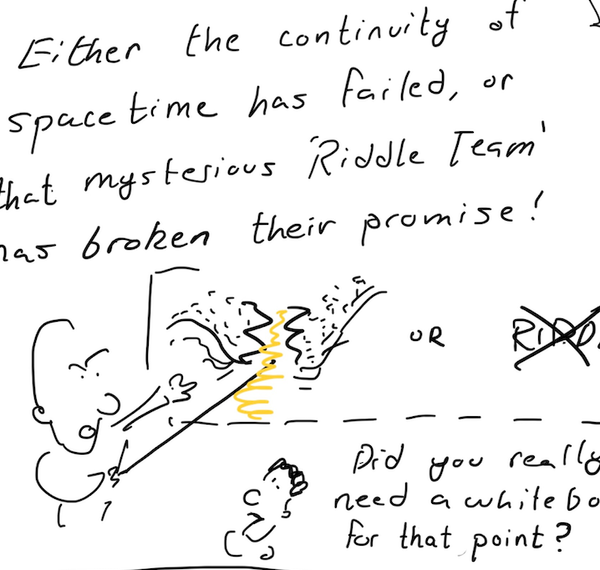
No blogger wants to produce shallow fluff, and no reader want to do nothing but skim. Yet, because so many readers skim, writers feel forced to simplify; because the writing is simple, readers skim all the more. It's a destructive cycle – and at its root is scrolling.

“He that writes in blood and proverbs wants not to be read, but learnt by heart...”
— Friedrich Nietzsche, Thus Spoke Zarathustra
"Them that write long scrolling webpages want not to be learnt by heart, or even really read, but skimmed and forgotten..."
— The Riddler, A Polemic Against Scrolling
I needn’t enumerate the glories of writing on the internet — the low barrier to entry, the ease of dissemination, etc — but I must pick a bone with one particular, and rather vital problem, with writing online: your writing must be read online.
If I handed you a stack of papers with words scribbled over them, we have a well-defined understanding of what ‘reading’ these papers means. I can expect that, if you read them at all, you will do so while sitting quietly, turning thoughtfully from one page to another, perhaps while stroking your chin and uttering “My word!” or “The nerve of that man!” And, if you come back to me with this stack of papers and claim to have read them, we both agree that this means that you spent a few minutes going over the words on each page, and have formed some opinion of their argument.
By contrast, if I send you a link to a website, with an earnest entreaty to “read it,” what does this mean? Do I expect you to print the website out, don your monocle, and page through it by hand?
Not remotely. In fact, I can’t form much of an expectation at all. You might open the link on your phone while waiting in line at the airport, and flick through it while looking up and shuffling forward every minute. You might pull it up on your laptop, leave it in an open tab for a week, and then happen upon it and spend ten minutes scrolling through it. If you are something of a nerd who spends too much time reading about digital tools, you may even have a system: every incoming link gets captured in a “read-it-later” app like Pocket, Instapaper, or Matter, where you later return to “process” all of your reading in batches, in a mostly losing battle to keep “read-it-later” from coming to mean “read-it-never”. In the typical fashion of modern technology, the online article is so flexible that our dear old analog conventions have been replaced with the (mostly arbitrary) choices of the programmer. But these choices have formed their own conventions, and they do not portend well for reading comprehension.
Reading, and in particular, deep reading is a fragile miracle. Evolution equipped us with language and a propensity to tell stories, but not by preparing manuscripts with thousands of little symbols, and then sitting quietly for hours to decipher them. It took us tens of thousands of years with spoken language to invent written language. And it took thousands of years' experimentation with written language to settle on a means of using written language well.
The first writing systems had no spaces; this mimicked the continuous flow of sounds from a speaker’s mouth. The first reading systems (e.g. scrolls of parchment) had no pages, mimicking the continuous flow of thoughts from a writer’s pen. For thousands of years, literacy remained not only confined to an educated elite (monks and scribes) but was so effortful – requiring a laborious sounding out of words – that even St. Augustine recorded his astonishment at finding his mentor reading a manuscript in his head. [1][2]
And try reading something in the old scripto continua, and you might understand Augustine's astonishment:
THEFIRSTWRITINGSYSTEMSHADNOSPACESEHISNTTHISRATHERHARDTOREADESPECIALLYIFITGOESONANDONANDONWITHNOCLEARDELINEATIONOFTHOUGHTANDSEQUENCE[3]
Spaces aside, readers faced another obstacle: the "continuous scroll". How to read something exceeding a few hundred lines from a scroll of parchment?
The problems are eerily familiar. For one, changing your position in a scroll requires work. You may be closely following some line of thought when — gah! — the text runs out of view, forcing you to spend perhaps ten seconds shifting the parchment to the side, or “scrolling.” And after reading through the scroll, good luck finding that pithy quote you recall being somewhere in the middle. Most of the scroll is ‘somewhere in the middle’; it’s all in a great continuum along one practically infinite dimension.
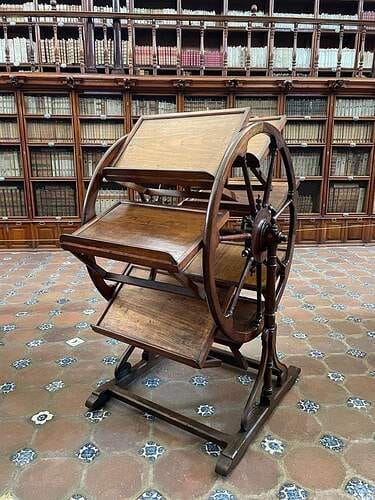
Then, along came the codex — the paginated, double-leafed, double-sided format of the modern book. It adds a whole new dimension to books: on scrolls, the text just went down — forever. But in the codex, text runs both down the page, and behind the page, giving the reader a natural indicator of progress, and a means of spatial memory.[4]
These evolutions reflected a gradual cottoning-on to a quirk of human psychology. We may speak and think in a freeform continuous ooze — but we process information better in chunks, whether on the scale of words, pages, sections, or chapters.[5] Most of the writer's work is marshaling that continuous ooze of her thoughts into a form comprehensible to others. The reading technology of sentences, pages, chapters and headings assisted in that translation.
And for centuries, the codex reigned supreme over a golden age of literacy. Then, thirty years ago, it fell suddenly into digital senescence. Online publishers and their audiences enthusiastically reverted to the older, inferior reading technology of scrolling, birthing a world of skimming readers and skimmable writers and precipitating the decline of Western civilization.
What happened?
Jaron Lanier described 'technological lock-in': the process whereby suboptimal first iterations become so widely used they're impossible to change.[6] The website is a child of the text editor, and a grandchild of the typewriter; it inherited the paradigm of a single infinitely tall page filled with words. This saved Tim Berners-Lee the work of having HTML code adapt itself to screens of varying sizes: just scroll it, like a text editor! Sure, that makes reading prolonged documents more difficult, but anyone reading a lengthy web page would print it, not read it on tiny CRT monitors. So we got the scrolling web page as our first iteration of online reading.[7]
Then screens improved, printing documents became less frequent, and scrolling continued to gain popularity. Trackpads (and later iPhones) made it feel immediate and tactile – there were animations! And, reinforcing and reinforced by this, was the sort of content that came to dominate the internet: not Neal Stephenson-style five-thousand word essays, but Buzzfeed listicles and ad-laden muffin recipes.
Around this point, Stockholm syndrome set in. Those who grew up with the internet were so used to the scrolling paradigm that they grew offended by anything outside it. Quoth the stereotypical web developer: "the first law of web design is don't mess with the scroll."[8] Websites that messed with scrolling earned a special term of derision: "scrolljacking". And enough of the web has evolved around the expectation of scrolling that trying to roll one's own pagination is a significant challenge. (Remember Microsoft Edge's paginated reading mode? It didn't last long.[9])
Along the way, a lot of old work-arounds for the pagination hold-outs have failed. The space bar (or PgUp and PgDn keys) used to let you navigate pages in discrete chunks[10]; now a majority of websites have broken this with weird headers and footers that result in too much content being scrolled. Even printing web pages – the original pagination solution – now frequently fails to include images, thanks to modern web development "best practices" like lazy-loading. Even most PDF viewers now default to a continuous scrolling view. And scientific publishers, one of the last bastions of the PDF, are now prominently experimenting with HTML versions of their articles[11].
The scroll has become inescapable[12]. We've been locked in.
You’ve read my polemic. Now for the plea: App-makers, webmasters, big and small, let's reconsider the scroll. If you make an app where reading words on the screen is a big part of the user experience, for God's sake, let there be pages! If you’re a publisher or a blogger, consider using one of the below libraries to give your readers the most sophisticated, cognitively ergonomic, enjoyable reading experience — or at the very least make sure that the PgUp and PgDn buttons actually work on your site, and that it can be printed into something resembling a comprehensible document. Perhaps even offer downloadable epubs of your longer articles, if only as a subscriber perk! Help those who read your site read it deeply.
The challenge here is not technical, not ideological, but simply of getting enough momentum to escape scrolling’s technological lock-in.
No blogger wants to produce shallow fluff, and no reader want to do nothing but skim. Yet, because so many readers skim, writers feel forced to simplify; because the writing is simple, readers skim all the more. It's a destructive cycle – and at its root is scrolling.
So let's kill the scroll. Let's tear it to pieces. And after it dies, piece them together where they belong: as pages.
Follow Up
Tools for Readers
Between the time I started this polemic and the present, Readwise Reader, a prominent read-it-later app, introduced their own take on pagination. They're not alone: venerable read-it-laters Instapaper and Pocket have legacy versions of this feature going back a decade. Yet outside the world of e-ink readers, pagination remains an aberration.
If anything I've written resonates with you, I implore you try one of these products. Throw money at them and urge their competitors to implement pagination of their own.
- The E-ink Bro mobile web browser lets one jump through webpages with volume buttons. And save webpages as EPUBs. It's marvelous, yet sadly only available for Android on F-droid.
- E-ink Mode extension (Firefox, Chrome), including Firefox on Android, for turning any website into a nice paginated experience.
Tools for Bloggers
To support pagination in the browser - as a gentle nudge to read more mindfully:
Making the page print/PDF friendly, including recommended CSS printmedia stylesheets:
- https://www.devzery.com/post/print-friendly (2024)
- https://www.reddit.com/r/web_design/comments/6ui3ha/best_practices_for_making_a_website_printer/ (2017)
The Science
Scrolling is measurably terrible for comprehension:
To scroll or not to scroll: scrolling, working memory capacity, and comprehending complex texts - PubMed: "Results from both studies indicated that a scrolling format reduced understanding of complex topics from Web pages, especially for readers who were lower in working memory capacity."
One might snarkily note the 'especially for readers...lower in working memory capacity'. Not so quick! Multitasking (an ambient digital activity) reduces working memory capacity.
And even paginated e-ink readers have lower comprehension than physical books:
Comparing Comprehension of a Long Text Read in Print Book and on Kindle: Where in the Text and When in the Story? - PMC: "on most tests subjects performed identically whatever the reading medium . However, on measures related to chronology and temporality, those who had read in the print pocket book, performed better than those who had read on a Kindle. It is concluded that, basically comprehension was similar with both media, but, because kinesthetic feedback is less informative with a Kindle, readers were not as efficient to locate events in the space of the text and hence in the temporality of the story."
Not unlike the veneration even trained musicians have for those wunderkinds that can silently read a score and mentally hear the symphony. ↩︎
From Was Silent Reading Unusual During Augustine's Time? : History of Information
↩︎In "Toward a Sociology of Reading in Classical Antiquity
 ," American Journal of Philology 121 (2000) 593-627 William A. Johnson quoted Augustine's passage from the Confessions concerning the reading habits of his mentor, the archbishop of Milan, Aurelius Ambrosius, who read silently. The inference is that silent reading was unusual in Augustine's time:
"When Ambrose read, his eyes ran over the columns of writing and his heart searched out the meaning, but his voice and his tongue were at rest. Often when I was present—for he did not close his door to anyone and it was customary to come in unannounced—I have seen him reading silently, never in fact otherwise. I would sit for a long time in silence, not daring to disturb someone so deep in thought, and then go on my way."
One reason even the modern Kindle can't compete with the physical book: "on measures related to chronology and temporality, those who had read in the print pocket book, performed better than those who had read on a Kindle. It is concluded that, basically comprehension was similar with both media, but, because kinesthetic feedback is less informative with a Kindle, readers were not as efficient to locate events in the space of the text and hence in the temporality of the story." ↩︎
Lanier's book, "You are Not a Gadget" - highly recommended. ↩︎
And we all know how permanent temporary solutions can be... ↩︎
E.g. https://dontfuckwithscroll.com/, https://www.nngroup.com/articles/scrolljacking-101/ ↩︎
Introduced in 2017, with fanfare — 'Edge, the browser built for reading' — then silently deprecated two years later. It doesn't appear to have been mourned by the digiterati/technetariat. Noted one blogger, "I prefer the Reading View in the new Edge to that of classic Edge, which, for some reason, sports a horizontally-scrolling layout that is contrary to how most of the web works. In the new Edge, Reading View uses a normal and familiar vertical layout that scrolls up and down." src RIP the Edge Horizontal scroll. ↩︎
This 'productivity hack' was one subject of David Pogue's 2013 TED Talk ↩︎
Anthropic's few research 'papers' — pioneering works of no small importance — are only published as giant scrolling webpages on transformercircuits.pub. Woe to the researchers who can't concentrate fully while scrolling around in a browser. One wonders how much ML interpretability has been set back by Anthropic's choice of a medium more conducive to skimming than to understanding. ↩︎
The conspiracist in me would add that perhaps this spread of an digital medium that discourages deep reading was not wholly accidental. Google, for one, has a financial motivation to keep its users hopping between links, rather than dwelling deeply on any one result. And being the primary entry point to the open web, their ideas about style have unreasonable influence. E.g. Google is to blame for the long rambling preambles of most all recipe bloggers, who add filler verbioge for search optimization. May they also be behind the strange merger of the historically separate acts of 'finding something to read' and 'reading it'? -- replacing the early-internet practice of foraging for and downloading of PDFs and books to be consumed offline with the terminally-online mode of reading while link-tripping. ↩︎